Invest in Mutual Funds.
Access a world of funds, managed by institutional investment professionals. Mutual funds provide an efficient gateway to a wide array of investments.
Access a world of funds, managed by institutional investment professionals. Mutual funds provide an efficient gateway to a wide array of investments.
Investments can go down in value as well as up, and you may get back less than you put in. See our full risk disclosure for details.
Mutual funds are investment vehicles that pool money from many investors to purchase a diverse portfolio of securities. Key features include:
Institutional fund managers make investment decisions on behalf of investors.
Each fund typically holds a variety of stocks, bonds, or other securities.
Funds often offer different share classes with varying fee structures.
Mutual funds are subject to strict regulatory oversight to protect investors.
Gain exposure to numerous securities through a single investment, spreading risk across various assets.
Benefit from the knowledge and experience of professional fund managers who actively research and select investments.
Start investing with relatively small amounts, making it easier for beginners to enter the market.
Access institutional-level investing power, potentially reducing transaction costs compared to individual investing.
Gain exposure to numerous securities through a single investment, spreading risk across various assets.
Benefit from the knowledge and experience of professional fund managers who actively research and select investments.
Start investing with relatively small amounts, making it easier for beginners to enter the market.
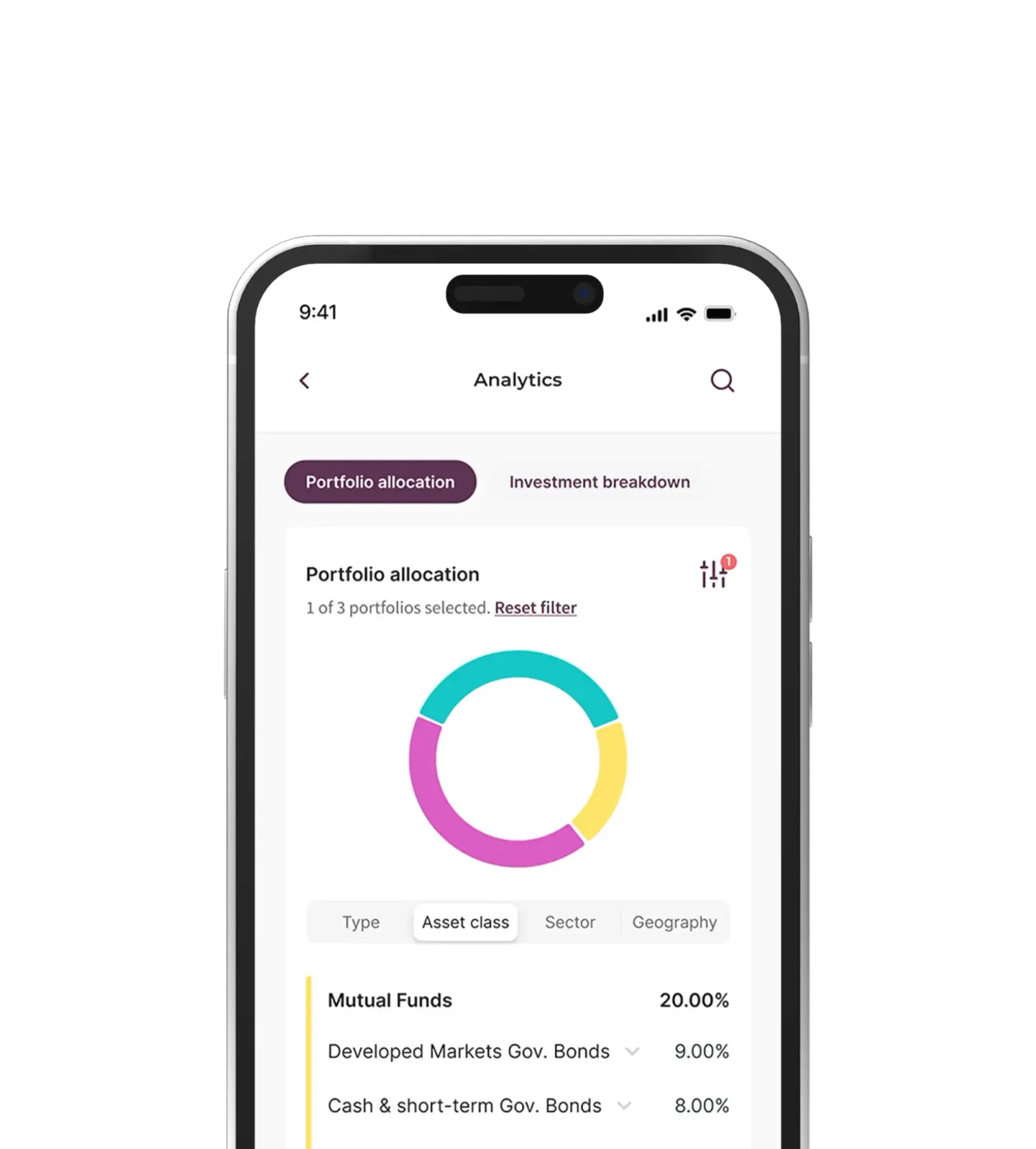
Our Analytics feature provides you with real-time oversight of your portfolio’s global diversification. Maintain a comprehensive view of all your investments, whether they're managed by us or independently by you.
View how your investments are spread by Type, Asset Class, Sector, and Geography. Analytics offers a consolidated view of all your wealth, bringing greater clarity to your investing journey.
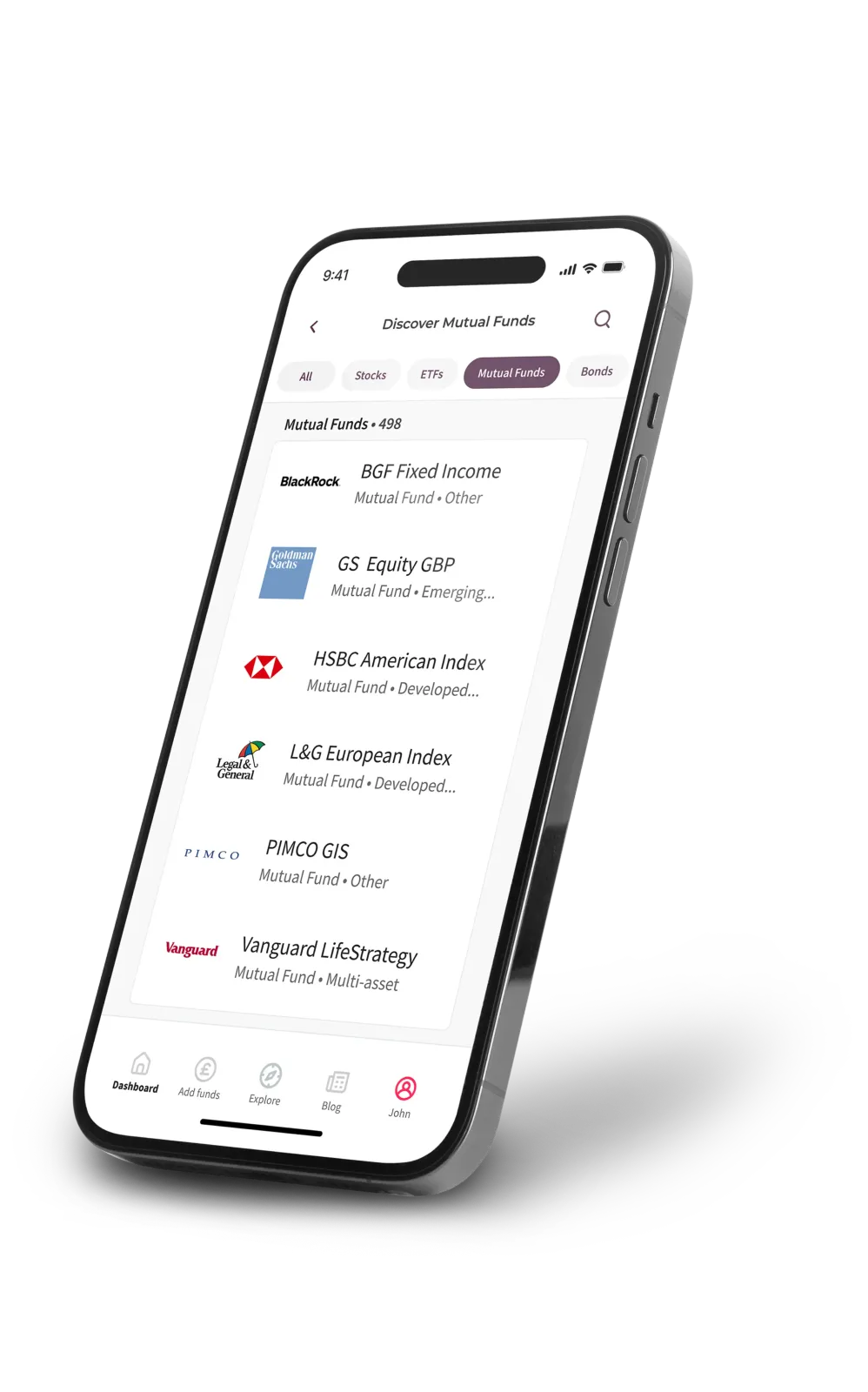
Access a diverse investment universe of 1,000+ individual stocks, ETFs, bonds, and mutual funds.
Build your own diverse portfolio or invest alongside our expertly managed, globally diversified options to take full advantage of our expertise.
Build a portfolio that truly reflects your values and wealth goals. Shape your investment journey, one carefully chosen asset at a time.
Access a diverse investment universe of 1,000+ individual stocks, ETFs, bonds, and mutual funds.
Choose to invest your own way and let our questionnaire guide you.
Select your account type – Stocks and Shares ISA or General Investment Account – and fill in your details.
Start building your portfolio with access to our research tools and expert insights.
Mutual funds have long been one of the most widely used investment vehicles for individual investors. By pooling money from many investors into a professionally managed portfolio, mutual funds provide access to diversified exposure across markets, sectors and asset classes.
Whether you are building a long-term portfolio or looking to complement existing investments, mutual funds offer a structured way to participate in financial markets without having to select individual securities yourself.
A mutual fund is an investment vehicle that collects money from multiple investors and invests it in a diversified portfolio of assets. These assets may include shares, bonds, money market instruments or a combination of different securities.
Each investor owns units (or shares) in the fund, representing a proportionate share of the underlying holdings. The fund is managed by professional portfolio managers who make investment decisions based on the fund’s objectives.
Unlike ETFs, which trade throughout the day on stock exchanges, mutual funds are typically priced once per day after the market closes. All buy and sell orders are executed at that day’s net asset value (NAV).
There are several categories of mutual funds, each designed to meet different investment goals and risk profiles:
Equity Funds
These invest primarily in shares and aim for capital growth. They tend to carry higher risk but also higher long-term growth potential.
Bond Funds
These focus on fixed-income securities such as government or corporate bonds. They are generally considered less volatile than equity funds, though returns may be lower.
Balanced or Multi-Asset Funds
These combine equities and bonds within a single portfolio, offering built-in diversification.
Money Market Funds
These invest in short-term debt instruments and aim to preserve capital with modest returns.
Sector or Thematic Funds
These focus on specific industries, regions or investment themes.
Understanding the fund’s objective, asset allocation and risk level is essential before investing.
Mutual funds offer several advantages for investors:
Diversification
By holding multiple securities within one fund, investors reduce exposure to the performance of any single company or asset.
Professional Management
Fund managers conduct research, monitor markets and make allocation decisions on behalf of investors.
Accessibility
Mutual funds provide exposure to markets and strategies that may otherwise be difficult or costly to access individually.
Simplicity
For those who prefer not to manage individual securities directly, mutual funds offer a streamlined approach to investing.
Like all investment products, mutual funds charge fees. These may include:
Fees reduce overall returns over time, so it’s important to understand the total cost structure before investing. Even small differences in annual charges can have a significant impact on long-term performance.
Comparing fees alongside performance consistency and investment approach can help you select funds aligned to your goals.
While mutual funds offer diversification, they are not risk-free. The value of your investment can go down as well as up, depending on market conditions.
Key risks may include:
Because mutual funds are market-based investments, they are typically better suited to medium- and long-term financial goals rather than short-term savings needs.
Mutual funds and ETFs share similarities — both pool investor capital into diversified portfolios. However, there are structural differences.
Mutual funds are priced once daily and do not trade intraday, while ETFs are bought and sold on exchanges throughout market hours. ETFs often have lower expense ratios, particularly when tracking indices passively.
Mutual funds, on the other hand, may offer more actively managed strategies and structured investment approaches.
The choice between the two depends on your investment style, trading preferences and cost considerations.
Mutual funds can serve as core building blocks within a diversified portfolio. By combining different types of funds — for example, equity and bond funds — you can tailor your overall asset allocation to match your risk tolerance and financial objectives.
Some investors prefer to select individual funds directly, while others follow model portfolios that integrate multiple funds into a cohesive strategy.
Regular investing can help smooth the effects of market volatility, particularly when investing over longer time horizons.
Mutual funds may be suitable if you:
As with all investments, capital is at risk and returns are not guaranteed. Past performance does not predict future results.
Mutual funds remain a cornerstone of modern investing. By combining diversification, professional management and accessibility, they offer a structured way to participate in financial markets.
When selected thoughtfully and aligned to clear objectives, mutual funds can play an important role in building long-term financial growth. The key is understanding your goals, assessing your risk tolerance and maintaining a disciplined investment strategy over time.
Access institutional-level investing power, potentially reducing transaction costs compared to individual investing.
Build a portfolio that truly reflects your values and wealth goals. Shape your investment journey, one carefully chosen asset at a time.
Sign in
©2025 MFM INVESTMENT Ltd
Registered office: 90-92 Pentonville Road, London N1 9HS | Registered in England and Wales Company No. 09088155 | Telephone number: +44 (0)20 3745 6991 | VAT No. 467458154
Moneyfarm is a trading name of MFM Investment Ltd, which is authorised and regulated by the Financial Conduct Authority (FCA Firm Reference Number: 629539)
Products
Authorised and regulated by the Financial Conduct Authority as an Investment Advisor and Investment Management Company - Authorisation no. 629539
This company meets high standards of social and environmental performance, transparency and accountability.
Moneyfarm uses an encrypted connection to protect your data.
No.
Investments cannot be transferred to and from foreign intermediaries as the tax regime is different.
If we are unable to transfer a particular instrument to your Share Investing account, we will only transfer the available instruments.
The transfer process can take up to 30 days
Withholding Tax is levied on investment income from many non-UK markets, such as dividends received, and is withheld at the source of income and paid to the tax authorities where the company is incorporated. The amount of tax payable depends on the source country and the type of income received. If you are entitled to a lower tax rate under a tax treaty, you may attempt to recover part of the withholding tax by contacting the tax authorities in the source country.
As with all your investing with Moneyfarm, we take care of how much tax you owe at year end so you always know what’s due.
There’s no cost to open a Moneyfarm Share Investing account. Just choose a Stocks and Shares ISA and/or a General Investment account and take it from there. There are order fees and, for an ISA, custody fees.
Your buy or sell order automatically expires if it’s not completed by 5.00pm the same day, when the market closes.
This is when your buy or sell order remains in place until either it’s completed or you cancel it.
Market order. This is a request to buy or sell as soon as possible at a price very close to the current market price.
Limit order. This lets you set a minimum (selling) or maximum (buying) price for your order. Your order will never be executed at a higher price (when buying) or price lower (when selling) than your limit price.
PTM (Panel of Takeovers and Mergers) is a £1 government levy that is automatically charged to investors when they buy or sell shares for over £10,000.
Our fee structure is straightforward: £3.95 for each trade and 0.35% custody fee (ISAs only).
You can invest in UK Stocks and ETFs, though we’re paving the way to give you even broader access to the financial markets.
Our investment consultants can answer technical questions relating to Moneyfarm Share Investing, provide factual information about the financial products we offer.
Once invested you’ll see a range of ways to view and assess your holdings and inform your strategy – particularly insightful when used across both Share Investing and a Moneyfarm managed portfolio. In future releases, we will also provide insights into your investing journey and help you make informed decisions.
You will be able to open a GIA or an ISA Share Investing account. JISA and SIPP are currently not supported with regards to this service.
Share Investing is a brand new service that allows you to invest in UK single name stocks, shares and ETFs, enabling you to make well-informed decisions that fit your attitude to risk and your financial goals. All accessible via the Moneyfarm app and platform.